Guide · 2026 · MBA admissions
MBA résumé in Harvard format: the 2026 template
If you're applying to HBS, Stanford GSB, Wharton, MIT Sloan, INSEAD, Kellogg, Booth, or Tuck, the single-page Harvard-format résumé is what admissions committees expect on round one. This guide breaks down what they actually look for, where applicants get rejected at first glance, and how to build yours in 15 minutes.
What does an MBA resume in the Harvard format look like?
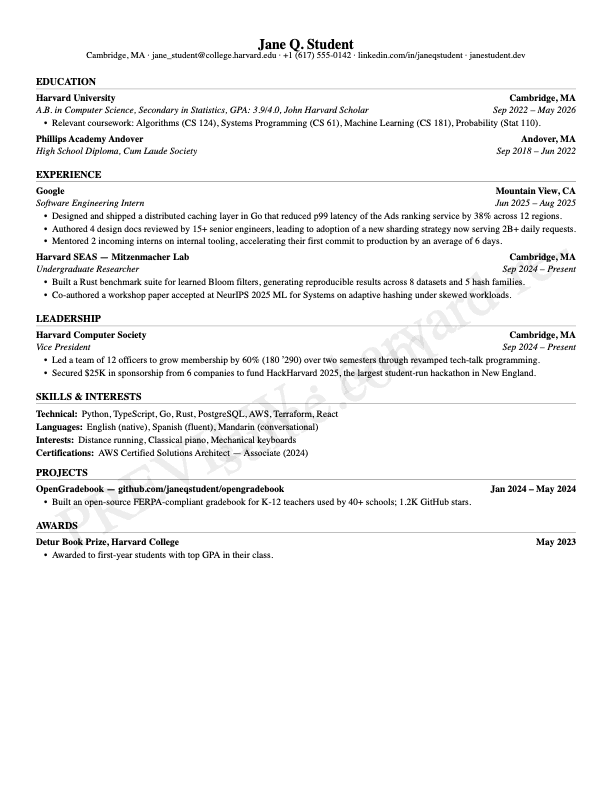
An MBA resume in the Harvard format is a single page with the applicant's name and contacts at the top, then six sections in order: Education, Experience, Leadership, Skills and Interests, and optional Awards. Each role uses quantified X-Y-Z bullets, with no photo, objective, or graphics.
1. Why MBA committees prefer Harvard format
An admissions reader at a top-15 program sees 50-80 applications per day during peak round. They spend, on average, 90 seconds on your résumé before either continuing into your essays or moving on. The single-page Harvard format is engineered for exactly this kind of read: it lets them extract school, role, and quantified results in the first ten seconds, then spend the next eighty validating the story those data points suggest.
The format isn't a Harvard exclusive. Stanford GSB's admissions blog calls it “the standard professional CV format”. Wharton's career office uses it as the baseline for OCR (on-campus recruiting). MIT Sloan's optional questions explicitly assume you submitted a one-page résumé in this style. INSEAD's Career Services recommends it for the post-MBA job search. The reason these schools converge on it is straightforward: the format prioritises signal over decoration, and admissions committees optimise for signal.
2. Anatomy of a winning MBA résumé
The six sections, in this exact order:
- Header — full name centered in 14pt bold; one line below with email, phone, location (city/country), LinkedIn URL, and a personal site if you have one. No photo. No date of birth. No marital status.
- Education first, in reverse-chronological order. Each entry: institution + location (bold left, plain right), degree + GPA + honors in italics, dates right-aligned. Include relevant coursework only if it changes how the committee reads you (e.g. quantitative coursework if your undergrad was non-STEM).
- Experience — three to five entries, each with two to four bullets following the X-Y-Z formula: accomplished X, as measured by Y, by doing Z. Quantify everything: revenue, headcount, percentage growth, time saved, customers acquired.
- Leadership — clubs, student government, volunteer roles in which you held a title and produced measurable outcomes. This section is where applicants differentiate; pre-MBA work is similar across the candidate pool, but leadership is biographical.
- Skills & Interests — four to six technical skills, two to three languages with fluency level, two to three genuine interests (not “reading”). This section humanises you and seeds interview conversation.
- Awards (optional) — only if academically or professionally significant. “Employee of the Month” does not belong; Detur Book Prize, Forbes 30 Under 30, or Fulbright Scholar do.
What's deliberately absent: an “Objective” section, a “Professional Summary” paragraph, testimonials, references, hobbies-as-personality, and graphical elements. None of these add information; all of them add cognitive load.
3. Differences across top schools
The shared format is the Harvard one. Schools differ in theemphasis they want within it:
- HBS — leadership and impact at scale. Bullets that show “led X people to deliver Y in Z months” outweigh bullets that show technical depth.
- Stanford GSB — “intellectual vitality” + change-the-world impact. Coursework and academic side projects matter more here than at HBS.
- Wharton — quantitative rigor + finance/analytics fluency. If your bullets aren't quantified, you look under-prepared for the curriculum.
- MIT Sloan — technical depth + invention. Patents, papers, open-source projects, and engineering accomplishments compound here.
- INSEAD — internationality + adaptability. Multiple countries, multiple languages, multiple sectors play better than a deep specialist track.
- Kellogg — team and brand. Marketing experience, consumer insights, and team-leadership stories thrive.
- Booth — analytical sharpness. Treat it like Wharton-lite for emphasis decisions.
- Tuck — community and tight cohort. Leadership in community-oriented roles weighs more than at coasts schools.
Practical implication: keep the same format across applications, but reorder bullets per school. Lead with the bullet most aligned with what each program selects on. The editor on this site lets you maintain multiple versions in parallel under one subscription.
4. Real example (download included)
The sample below is what a strong applicant might submit to a top-10 program. It's identical to what comes out of our editor when you fill in your own data.
“A résumé is a forcing function. If you can't fit your story onto one page, you don't have a story yet — you have raw material.”
5. How to build yours in 15 minutes
- Open the editor at harvard-resume.com/en/create. No signup or card required to start.
- Fill the sections top-to-bottom. The right pane shows your PDF updating in real time — exactly what you'll download.
- Use the X-Y-Z tooltip on each bullets field. The hardest part of a great résumé is converting raw accomplishments into measured-and-attributed bullets. The tooltip nudges you with the formula every time.
- Download the watermarked preview for free and share it with a current MBA student or your career coach. Get feedback. Iterate.
- When you're ready, the clean (no-watermark) PDF is $3.99 once, $9.99/month, or $39/year for unlimited downloads across multiple versions. See pricing.
Auto-save runs in the background. Sign in with magic link (no password) to keep your résumés on file across devices and applications.
6. Mistakes that get rejected at first read
- More than one page. The page count is itself a signal of judgment. A two-page MBA résumé says “I couldn't decide what mattered”.
- Unquantified bullets. “Responsible for managing client relationships” tells the reader nothing. “Managed $14M book across 9 Fortune 500 accounts; retained 100% during 2024 sector downturn” tells them everything.
- Buzzwords without evidence. “Synergised cross-functional initiatives”, “leveraged strategic frameworks”, “passionate self-starter” — every committee reader has trained themselves to skip these phrases.
- Photo, DOB, or marital status. Standard in some countries; a credibility hit on a US/UK MBA application.
- Inconsistent date format. “Sept 2022 – Present” on one line and “09/2022 – Now” on the next signals haste.
- Past tense for current roles. Use present tense for “Present” entries; past tense for completed ones. This is a tiny detail readers register subconsciously.
- References on the résumé. Don't. They go in the recommendation system, not the résumé.
7. R1 / R2 / R3 timeline
For a fall-2027 matriculation cycle:
Round 1
Sep 2026
- Highest acceptance rates
- Best for international applicants needing visa lead-time
- Résumé final by mid-August
Round 2
Jan 2027
- Most competitive pool
- Best for applicants who needed more recent results to show
- Résumé final by mid-December
Round 3
Apr 2027
- Small remaining seats
- Best only if you bring unusual diversity to the cohort
- Skip unless you have a compelling reason
Working backwards from these dates: start your résumé draft 8-10 weeks before submission so you have time for 3+ feedback rounds with mentors, current students, and a career coach.
Start your MBA résumé. Decide on payment later.
Free editor, free watermarked preview download. Pay only when you're ready for the clean PDF.
Open the editor8. Frequently asked
- Does Harvard Business School require a specific résumé format?
- HBS doesn't mandate a template, but their application portal includes a single-page resume requirement and their own Office of Career Services publishes the format described on this page. Submitting in that format means a reader spends zero seconds adjusting to your layout and 100% on your content.
- How long should an MBA application résumé be?
- One page. Without exception for applicants with less than 10 years of full-time experience. With 10+ years and significant senior-leadership credentials, a 1.5 page version may be acceptable at some executive programs, but never longer.
- Should I include my high school in an MBA résumé?
- Only if (a) your high school is internationally recognized (Phillips Exeter/Andover, Eton, Lycée Henri-IV, etc.) AND (b) you held significant leadership there. Otherwise, no — undergrad and forward.
- How is an MBA application résumé different from a regular job résumé?
- Three differences. First, education comes BEFORE experience even if you've worked 5+ years — admissions committees still anchor on academic credentials. Second, leadership is its own section (not buried inside experience). Third, bullets are written for non-industry readers; assume the reader doesn't know what your job involved day-to-day and write to that audience.
- Should I send a cover letter with my MBA résumé?
- Only if the program explicitly asks for one. Most don't — the essays are the cover letter. Wasted cover letters create extra reading work for the committee, which doesn't help you.
- Can I use the same résumé for multiple programs?
- Use the same format, yes. But reorder bullets within each role to lead with the result most aligned with what each school selects on (see Section 3). Our subscription tier lets you save up to 10 versions and download all of them clean.
- Will this résumé pass the ATS that schools use to filter applications?
- Yes — the PDF has selectable text, no embedded images, no multi-column layout, no exotic fonts. Tested against Workday, Greenhouse, Lever, and iCIMS (the ATS most commonly used by US universities and MBA recruitment partners).
Related
- Recruiting at McKinsey / BCG / Bain? — full guide for MBB and Tier 2 firms with structured-bullet examples.
- Pricing — $3.99 one-time, $9.99/month, $39/year.
- About this project — who we are and why we're not affiliated with Harvard.
- Harvard OCS Resumes & Cover Letters Guide (PDF) ↗ — the public document this page describes.