Engineering · 2026
Harvard Resume for Software Engineers
From new-grad to staff engineer — what FAANG and high-growth startups actually scan for.
How do I write a Software Engineers resume in the Harvard format?
Engineering hiring is unusually structural. Recruiters at Google, Meta, Stripe, Anthropic, and high-growth startups spend the first 8 seconds checking three things: education, last 2 roles, and tech stack. The Harvard format puts exactly those in the top third of the page. This recipe customises it for engineers from new-grad through staff level.
What recruiters look for
- Tier-1 CS undergrad OR strong portfolio (open source, side projects with traction)
- Tech stack named explicitly (not “strong in modern web technologies”)
- System-level bullets, not feature-level bullets
- Quantified scale: requests/sec, ms latency saved, users impacted, revenue moved
- Repos linked — GitHub URL or personal site under the contact line
Required sections, in this order
Header customisation
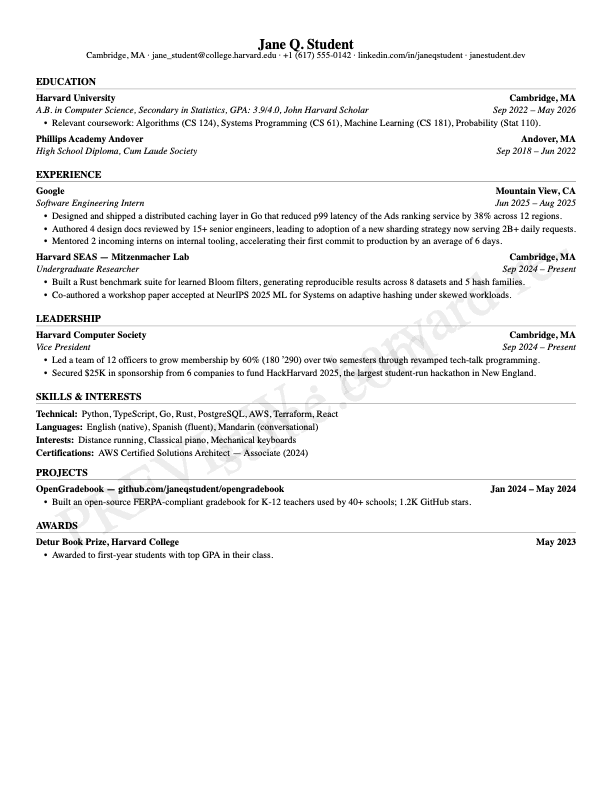
- Add GitHub link as second contact-line entry (after email)
- Optional: personal portfolio site, only if it has shipped projects
- No photo, no DOB, no marital status
Skills section placement
- Engineers can move Skills above Experience (unusual for other roles but accepted here)
- Group by category: Languages · Frameworks · Cloud/DevOps · Data
- List 6-10 items per group, not 20+
Projects section (recommended)
- Include for new-grads and switchers: 2-4 entries with repo links
- Each project: name, what it does in 1 sentence, your role, the metric (stars, users, papers cited)
Sample in Harvard format
Strong vs weak bullets
Worked on the search service to improve performance
Re-architected the search service’s caching layer in Rust, cutting p99 latency from 320ms to 84ms across 2.3M daily queries; rolled out behind a feature flag with zero customer-visible regressions
Names the language (Rust), the metric (p99 latency), the scale (2.3M daily queries), and the rollout discipline (feature flag, zero regressions). A reviewer infers production-grade engineering in 4 seconds.
Built a side project for tracking expenses
Built and shipped a personal-finance app to 1.2K monthly active users; designed the React Native front end, Node/PostgreSQL backend, and stripe-integrated payments; sustained 12% MoM growth without paid marketing
Specific stack, specific scale, specific growth rate — all without breaking the one-page constraint.
Mentored junior engineers on the team
Mentored 4 engineers from intern to junior IC; co-authored the team’s onboarding doc reducing time-to-first-PR from 18 to 6 days across the next cohort of hires
Mentorship is hard to quantify but here it is: 4 people, time-to-first-PR cut by 12 days, cohort-wide effect.
Mistakes specific to this role
- Listing every language you've ever touched. Recruiters trust depth over breadth — 4-6 languages you can actually be tested on.
- Generic “strong problem-solving skills” buzzwords. Replace with a specific algorithm or system you owned.
- Linking a portfolio site that 404s or shows lorem-ipsum. Always check the link before submitting.
- Listing GPA below 3.5 for FAANG-tier. Omit it and lean on shipped work or competitive programming results.
Your résumé starts here. Pay later.
Start composingFrequently asked
- Should I include LeetCode rating or Codeforces handle?
- Only if it's notable. Codeforces 1800+, LeetCode top 10%, or ICPC regionalist+ are worth listing under Skills or Awards. Below those thresholds, omit.
- Do I include personal projects without users yet?
- Only if the technical depth is unusual or the project is recent (last 12 months). A 2019 todo-app clone is a credibility hit; a 2025 distributed-ledger experiment is signal.
- Should I list open-source contributions separately?
- If you have 1-2 high-impact contributions (merged PRs to projects with >5K stars), include them as a bullet under each relevant project or under Experience. Don't create a separate section unless you have 5+.