Academia · 2026
Harvard Resume for Academic Faculty Applicants
Postdoc, junior faculty, and tenure-track applications expect a long-form academic CV — but the Harvard format anchors the front page.
How do I write a Academic Faculty Applicants resume in the Harvard format?
Academic CVs are long-form by design (5-15 pages is normal for tenure applications), but search committees read the first page exactly the way industry recruiters read a one-page résumé: 30 seconds, scanning for institution, degree, advisor, and headline publications. The Harvard format is the perfect first page of an academic CV — it puts what hiring committees pattern-match for in the top third.
What recruiters look for
- PhD-granting institution + advisor name + dissertation title
- Headline publications (Nature / Science / top journal in your field)
- Major grants (NSF, NIH, NSERC, ERC, Marie Curie)
- Teaching evaluations or named courses you've taught
- Service signals (peer review, conference organisation)
Required sections, in this order
First-page emphasis
- Education first with advisor + dissertation title in italics
- Selected Publications (3-5 max) in a section above Experience — only the ones you'd present at a job talk
- Major grants in a separate section if 2+; otherwise list under Awards
Beyond page 1 (linked or separate)
- Full publication list (with co-author asterisks, citation counts if strong)
- Teaching record with course numbers + enrolment + evaluation scores
- Service: peer review for X journals, NSF panel service, conference organising committees
- Mentees: PhD students supervised, postdocs hosted
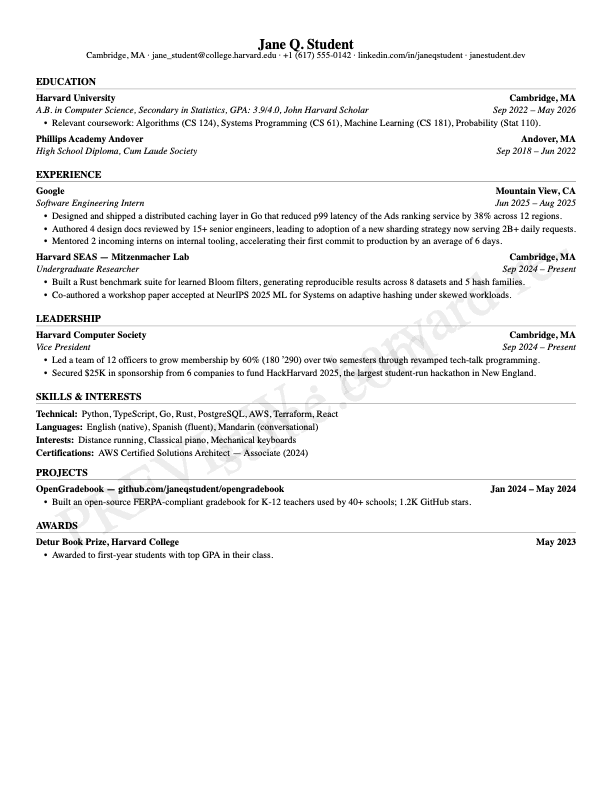
Sample in Harvard format
Strong vs weak bullets
Conducted research on transformer models
Co-authored 'Efficient Sparse Attention for Long-Context Transformers' (NeurIPS 2025, oral presentation, ~3% acceptance rate); reduced inference cost 38% at comparable accuracy on 4 standard benchmarks; cited by 47 papers within first 6 months including 3 from DeepMind, Google Research, Anthropic
Venue tier (NeurIPS oral, ~3% acceptance), specific technical contribution, measurable improvement, downstream impact with named institutions citing your work.
Won an NSF grant for my research
Principal Investigator, NSF CAREER Award #2541892 ($720K, 5 years, 2025-2030): 'Adaptive Sparse Attention Mechanisms for Transformer Architectures'; partnered with 2 industry labs (Anthropic, Hugging Face) for collaborator commitments
Specific award name (CAREER is recognised as junior-faculty prestige), funding amount, duration, your specific role (PI vs co-PI matters), and external partnerships strengthen the proposal narrative.
Taught undergraduate machine learning
Lecturer, CS 4780 'Machine Learning' (Cornell, Fall 2025): redesigned curriculum to include 4 weeks on alignment + safety; 187 enrolled (50% increase YoY); end-of-term evaluation 4.7/5.0 ranked 1st of 24 CS undergraduate courses that semester
Course title + number + institution + your specific contribution + enrolment scale + measurable evaluation + benchmark rank. A search committee infers you can run a serious teaching load.
Mistakes specific to this role
- Listing every paper you've published as 'selected'. Selected means 3-5, not 30.
- Omitting the dissertation title or advisor name from Education. Both signal lineage to the search committee.
- Hiding the journal name behind 'currently under review at top venue'. Specify if you can; if you can't (R&R), state it specifically.
- Padding teaching credentials with one-time guest lectures. List courses you owned + designed, not one-offs.
Your résumé starts here. Pay later.
Start composingFrequently asked
- Should I include altmetric scores or citation counts?
- Citations: yes if your h-index is competitive for your career stage. Altmetric: rarely — most search committees ignore it.
- Where do invited talks vs contributed talks go?
- Separate sections. Invited talks are higher-prestige and go first. Contributed talks list venue + paper title only.
- How do I list dual-affiliation appointments?
- Use both institution names in the Education or Experience line, comma-separated, with the primary affiliation listed first. Footnote the secondary affiliation with the specific role (e.g., 'Visiting Researcher').